Read these three fields together
A useful label reading takes three pieces of information: the amount of magnesium, the serving size, and the number of servings in the container. Each answers a different question.
- Magnesium per serving: how much of the mineral the label assigns to one complete serving.
- Units per serving: how many capsules, tablets, or scoops make that serving.
- Servings per container: how many complete servings the package contains.
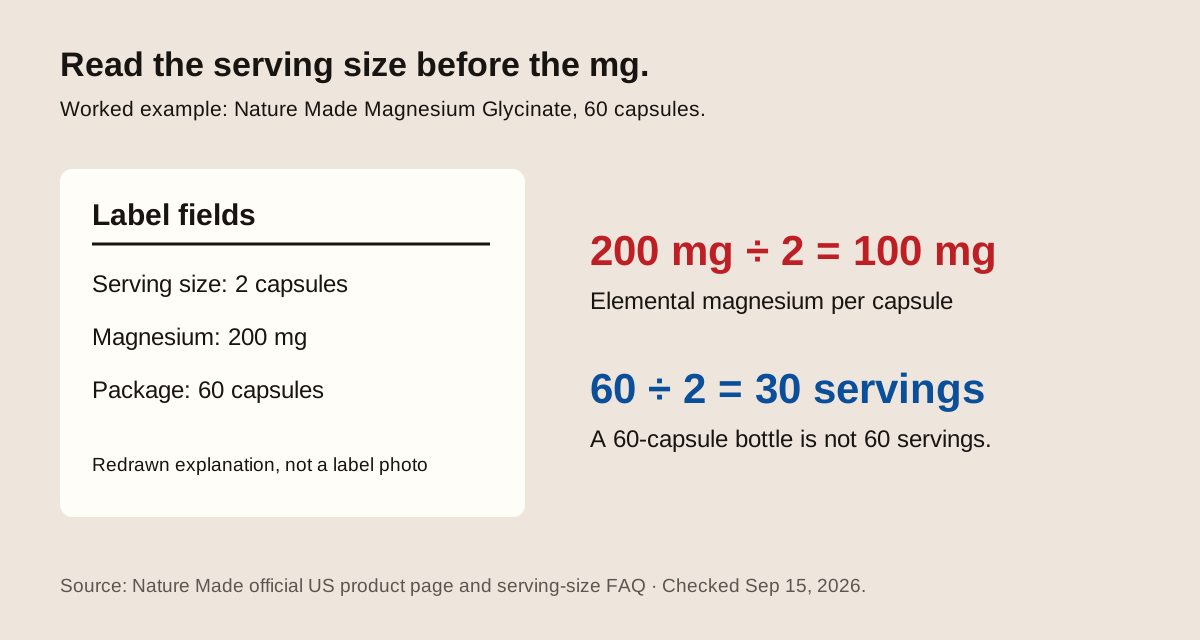
“60 capsules” tells you how many capsules you are buying. It does not tell you whether the bottle contains 60 days of use. A two-capsule serving makes 60 capsules into 30 servings; a three-capsule serving makes the same capsule count into 20 servings. Those are arithmetic results, not differences in absorption.
The NIH Office of Dietary Supplements specifies that a US Supplement Facts panel lists elemental magnesium, rather than the entire magnesium-containing compound. Read the ingredient name in parentheses to identify the source, then use the separately listed magnesium amount for the calculation.
Three current labels, worked through
The examples below use US manufacturer pages checked on September 15, 2026. They illustrate label reading and are not instructions to take a particular dose.
| Exact product and package | Label serving | Magnesium per serving | Calculated per unit | Servings in this package |
|---|---|---|---|---|
| Nature Made High Absorption Magnesium Glycinate, 60 capsules | 2 capsules | 200 mg | 100 mg per capsule | 30 |
| NOW Magnesium Citrate Veg Capsules, 120 capsules, SKU 1294 | 3 capsules | 400 mg | About 133.3 mg per capsule | 40 |
| Thorne Magnesium Bisglycinate, SKU M204 | 1 scoop | 200 mg | 200 mg per labeled scoop | 60 |
Sources: Nature Made's product page, its 100 mg per capsule explanation, NOW's product and package table, and Thorne's ingredient table.
NOW's page has several bottle sizes. Its default Supplement Facts display describes the 60-capsule package with 20 servings, while the separate package table assigns 40 servings to the 120-capsule bottle. Matching the package is essential: copying the default serving count beside another bottle's price gives the wrong calculation.
The “about 133.3 mg” entry is 400 divided by three. It is not an independent laboratory result for an individual capsule. The distinction matters because labeling arithmetic and laboratory measurement are different kinds of evidence.
Read an actual Supplement Facts panel
The manufacturer label below makes the serving calculation visible. “Serving Size 2 Capsules” appears above the magnesium entry. That entry declares 200 mg as magnesium bisglycinate, with 30 servings per container. Read those three lines together: the 200 mg belongs to two capsules, and the bottle contains 30 complete servings.
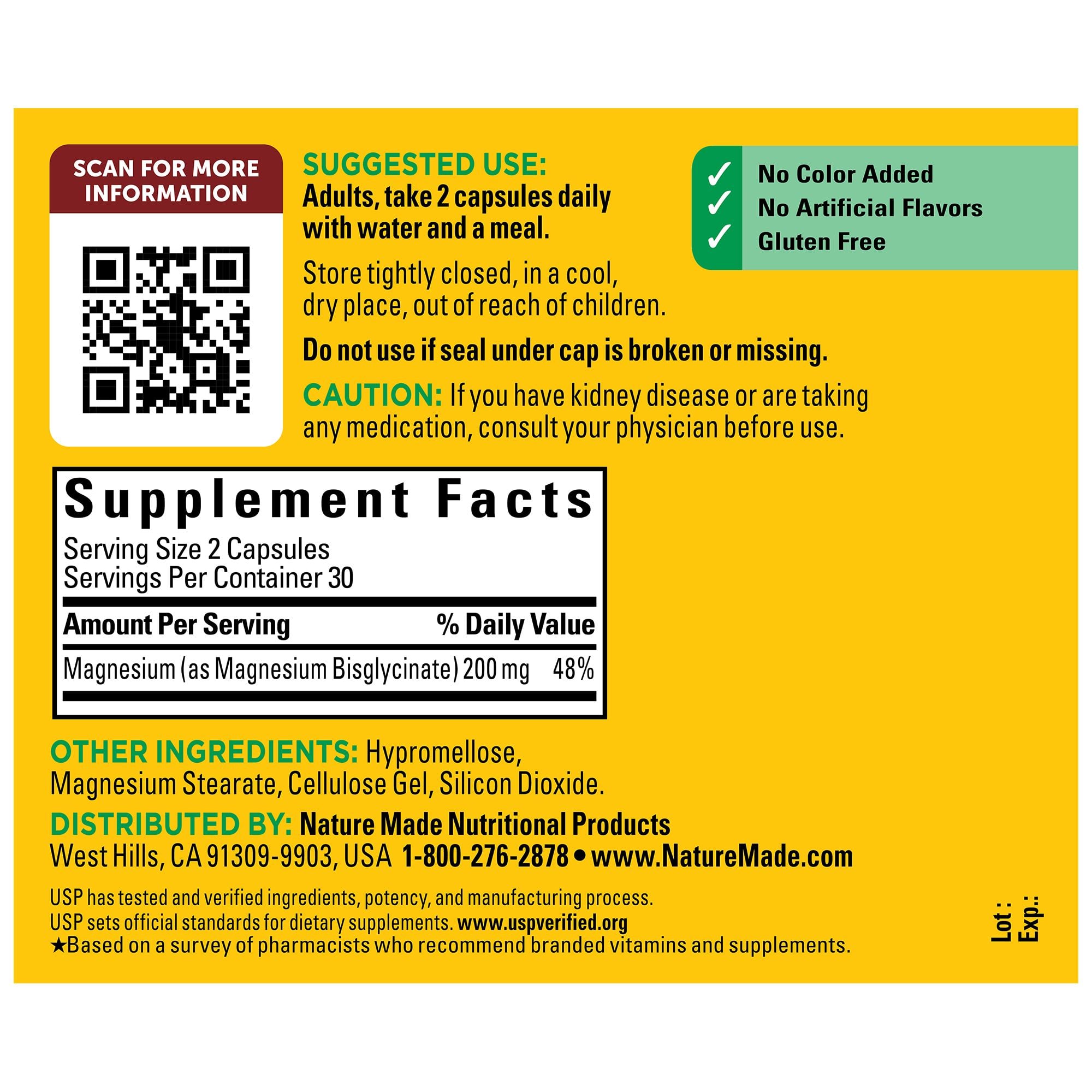
The image also separates the magnesium source from the other ingredients. Bisglycinate appears in the magnesium entry, while the capsule ingredients are listed below the facts panel. This is useful when a product uses “glycinate” on the front and “bisglycinate” in the details: you can see what the manufacturer actually declares instead of treating the shortened name as a second mineral.
Read the directions and cautions as separate information. The amount in Supplement Facts answers how much the labeled serving contains; the directions describe the manufacturer's suggested use. Neither the front image nor a seller's short title replaces the complete panel.
Compound weight and elemental weight are not interchangeable
An archived NOW label in the NIH Dietary Supplement Label Database gives a particularly clear example: 400 mg of elemental magnesium supplied by 2,667 mg of magnesium citrate in three capsules. The larger number includes the compound carrying the magnesium. It is not 2,667 mg of the mineral. Archived label, product code 1294
That archived label is an illustration, not a replacement for the current label. Formulas and packaging can change, so the current manufacturer specification and the bottle in your hand remain the relevant versions for a purchase.
Do not calculate elemental magnesium from a generic percentage found online when the product already declares it. Hydration state and mixtures can differ, and a marketing term such as “complex” may describe several ingredients. Reading the stated magnesium amount avoids pretending that an unspecified mixture has a known chemical composition.
If a blend lists several magnesium sources but only one total, you can compare that total. You cannot allocate the total among the individual sources without separate amounts. A list containing citrate and glycinate does not tell you how many milligrams came from each.
The Daily Value is not your supplement target
The US labeling Daily Value for magnesium is 420 mg. A 200 mg serving is therefore about 48% of that reference value, and 400 mg is about 95%. The Daily Value is a labeling reference, not a personalized prescription. FDA Daily Value chart
Another number serves a different purpose: the adult upper limit for magnesium from supplements and medications is 350 mg daily. Food magnesium is excluded from that limit. That is why a supplement can show less than 100% Daily Value and still exceed the supplemental upper limit. NIH magnesium fact sheet
The two numbers are not contradictory. One is a common reference for nutrition labels; the other addresses supplemental and medicinal intake. Neither means that every adult should buy a bottle that supplies the full amount.
Magnesium also comes from foods such as beans, nuts, seeds, whole grains, and leafy vegetables. A food-and-supplement record gives a more meaningful starting point than filling an imagined gap to 100% Daily Value using capsules alone. MedlinePlus: magnesium in the diet
Compare prices using the same amount
There are two useful price calculations. Cost per labeled serving answers what the manufacturer's complete serving costs. Cost per equal amount of magnesium lets you compare different serving sizes. Neither calculation estimates the amount your body will absorb.
For Nature Made's 60-capsule bottle at the checked price of $21.99:
- 60 capsules divided by two capsules per serving equals 30 servings.
- $21.99 divided by 30 equals $0.733 per 200 mg serving.
- $0.733 divided by 200, then multiplied by 100, equals about $0.37 per 100 mg.
For NOW's 120-capsule bottle at $19.99, 40 labeled servings make the cost about $0.50 per 400 mg serving, or $0.12 per 100 mg. Thorne's $52 container supplies 60 servings of 200 mg, giving about $0.87 per serving or $0.43 per 100 mg. Prices exclude shipping, tax, coupons, and subscriptions; all were checked on the linked manufacturer pages on September 15, 2026.
The lower normalized price does not make a larger serving appropriate for everyone. In particular, NOW's full 400 mg serving exceeds the adult supplemental upper limit. Use the calculation to compare value, not to select a dose.
Build a daily total without double-counting
Write down every product that supplies magnesium, including a multivitamin, a separate magnesium supplement, and any relevant medicine. Use the amount taken, not automatically the full serving printed on each label.
As an arithmetic example, a multivitamin supplying 50 mg plus a magnesium product supplying 200 mg totals 250 mg from supplements. Adding another product with 150 mg brings that total to 400 mg. These are hypothetical labels, not a recommended routine.
For powders, use the product's designated serving measure and instructions. A scoop from a different container is not interchangeable simply because both powders contain magnesium. Likewise, powder volume is not automatically powder weight, and powder weight is not automatically elemental magnesium weight.
Check the rest of the formula
The FDA distinguishes dietary ingredients declared in Supplement Facts from other ingredients elsewhere on the label. Its consumer guidance identifies both as information a supplement label must provide. FDA questions and answers on dietary supplements
For the Nature Made example, the other-ingredient list names hypromellose, magnesium stearate, cellulose gel, and silicon dioxide. The magnesium line above it remains the amount used in our comparison. The presence of the word magnesium elsewhere in the ingredient list does not supply a second declared mineral dose to add to the 200 mg.
A powder can add different practical considerations. Thorne lists citric acid and monk fruit concentrate, while NOW's citrate capsule lists hypromellose, ascorbyl palmitate, and silicon dioxide. A reader choosing an unsweetened capsule over a drink can use those verified differences without deciding that every unfamiliar ingredient is undesirable. Sources: the manufacturer pages linked with the table above.
For a formula with several active ingredients, make one row for each ingredient you intend to compare. Do not combine milligrams of magnesium, glycine, and another nutrient into a single “strength” figure. The substances differ, so that total would answer no useful nutritional question.
A sample label worksheet
A short worksheet can prevent mistakes when a retailer offers several sizes or changes the selected variation. For the Nature Made example, the completed entry is: 60 capsules, two per serving, 200 mg per serving, 30 servings, $21.99 one-time, checked September 15, 2026. Preserve the product URL beside that entry so another person can reproduce it.
Now change just the package to NOW's 120-capsule product. It would be wrong to carry over the two-capsule divisor from the first row. Its three-capsule serving makes 40 servings. Changing the brand or formulation means checking the whole row again, even when the listing uses the familiar words “magnesium capsules.”
Use a separate column for any amount a clinician has directed you to take. Keeping that column separate prevents a manufacturer's serving size from silently becoming your personal plan. It also prevents a price worksheet from being mistaken for dosing instructions.
When comparing a new bottle with an older bottle, retain the label version and package size. Thorne's certification records illustrate why: a listed 226.2 g container uses a 3.77 g scoop, while a separate 187 g record uses 3.11 g. Both describe magnesium bisglycinate powder, but the gross scoop weights differ. Sources: 226.2 g record and 187 g record.
What a readable label still cannot prove
A clear label tells you what the manufacturer declares. It does not, by itself, show a tested batch's measured potency, contaminant results, or a health outcome. Certification and laboratory documents answer separate questions.
Thorne's powder has a listing in the NSF Certified for Sport directory. That record identifies a product form, package, serving measure, and listed lots. Matching those fields is more informative than assuming a brand-wide badge applies to everything a company sells.
Is 200 mg per serving always 200 mg per capsule?
No. A two-capsule serving supplying 200 mg works out to 100 mg per capsule. Read the serving size before comparing amounts.
Can I divide a blend's magnesium equally among its listed forms?
No. A total for a blend does not disclose each form's contribution. Separate amounts are needed for that calculation.
Does price per 100 mg measure absorption?
No. It compares labeled quantities at the checked price. Absorption and clinical outcomes require different evidence.
Sources and calculation method
This guide uses official US labels and manufacturer pages, the FDA Daily Value chart, NIH labeling guidance, and the NSF directory. All price comparisons use one-time advertised product prices checked September 15, 2026. Calculations retain full precision before rounding to cents. No product was independently assayed for this article.
For the underlying form decision, read our companion guide, Magnesium Glycinate vs Citrate: How to Choose. For the separate medicine question, see magnesium citrate's bowel-action timing.
Read next
Prepared with AI-assisted research and writing. This article compares source documents; it does not report personal product testing or medical review.